Three case studies, three live demos

Ecommerce systems, taken apart and rebuilt.

Each case below starts from one commercial problem, not a visual refresh. Read the reasoning, then open the demo and click through the flow that actually shipped. Client names are left out; the work is described by what it changed.

3 ecommerce cases 3 clickable demos Marketplace · D2C · B2B Research → UX → UI → Handoff

Showing 3 of 3

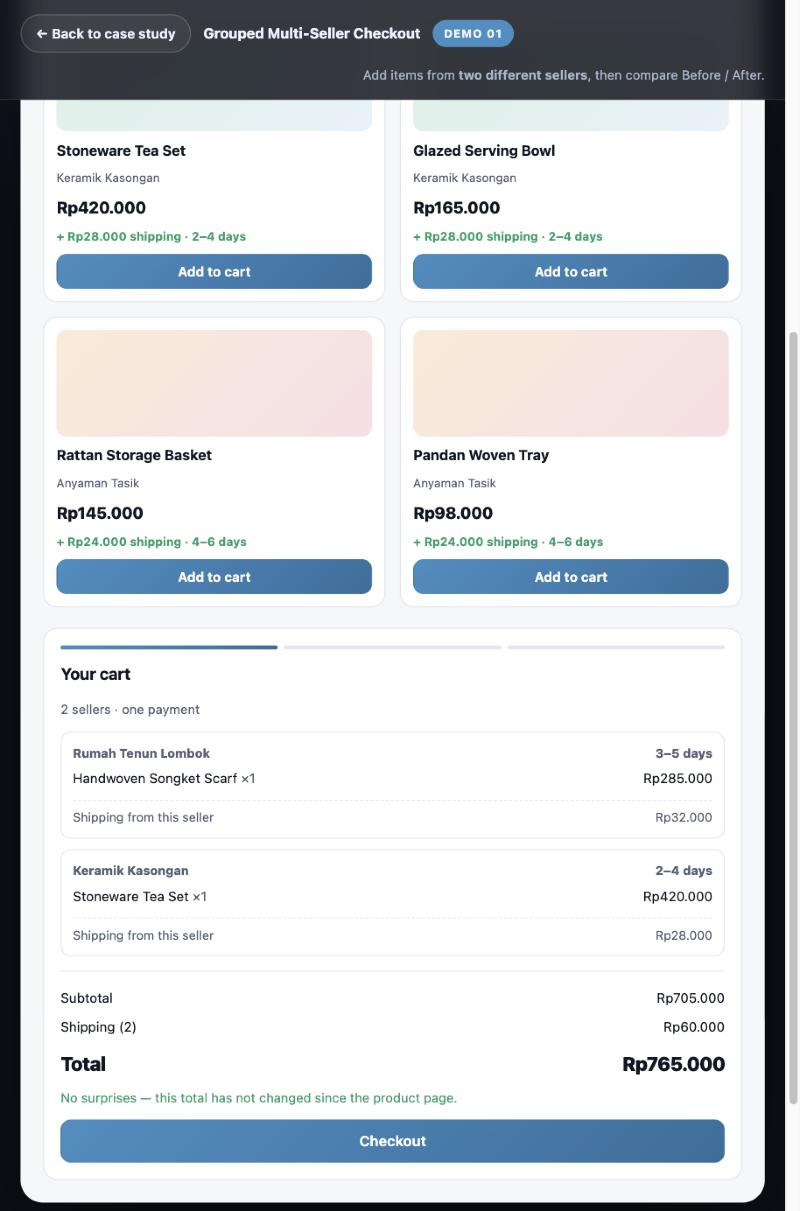
The redesigned cart showing items from two sellers grouped into one checkout, with each seller's shipping listed and a single total. Open demo ↗ Checkout drop-off −41%Conversion +28%
01 Marketplace Product Design Lead 10 weeks

Grouped checkout for a multi-seller marketplace

Seven of ten filled carts never reached payment, on a marketplace where almost every order spanned several independent sellers.

Problem

Orders containing items from different sellers were split into separate checkouts, each with its own shipping fee and payment step. Buyers met an unexplained price jump at the last screen and abandoned.

Approach

Session replays and fourteen buyer interviews located the exact drop frame. The split carts were merged into one grouped checkout, total landed cost was surfaced from the product card onward, and payment was reduced to a single confirmation.

Outcome

A grouped-cart checkout with per-seller shipping shown upfront, plus a 38-component design system handed to the engineering team.

−41%checkout abandonment
+28%conversion rate
+19%average order value
Open live demo ↗

Add items from two sellers, then compare the Before and After checkout models.

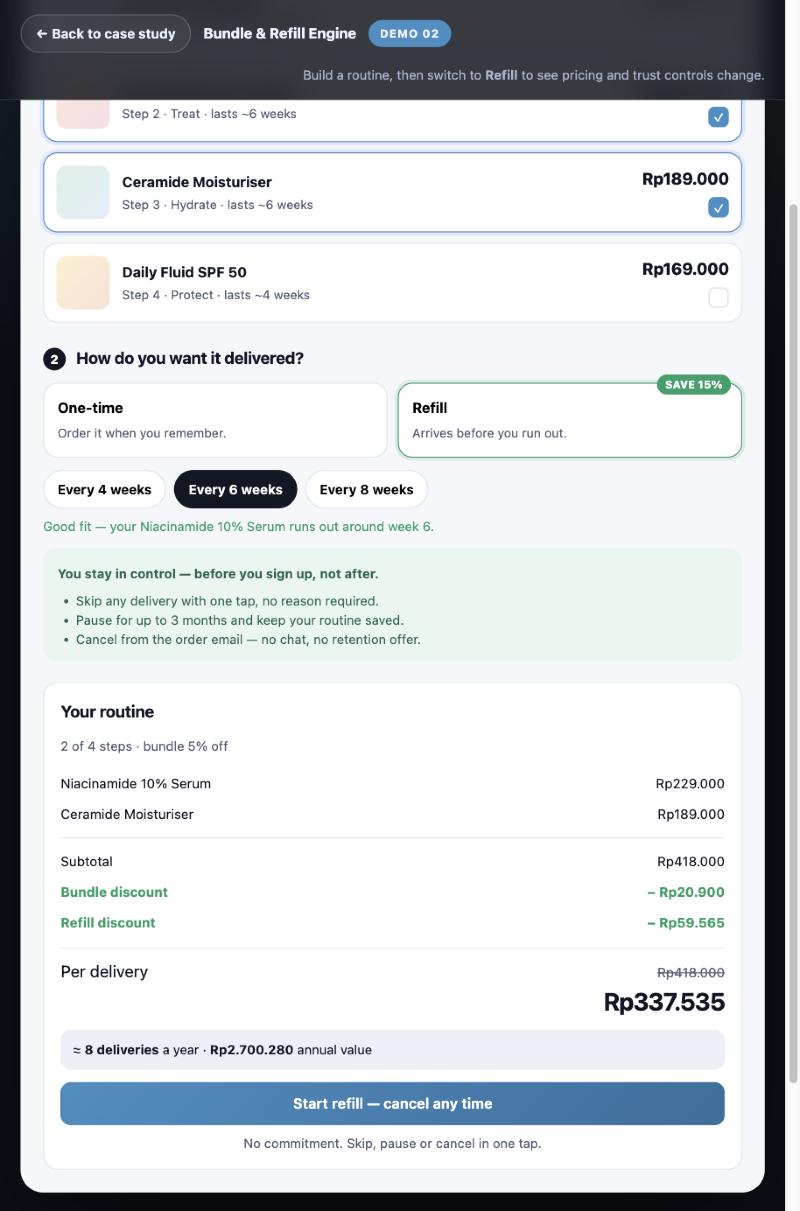
The routine builder in refill mode, showing bundle and refill discounts applied and the pause-anytime controls shown before signup. Open demo ↗ Repeat rate +34%Order value +52%
02 D2C Skincare Product & Systems Design 8 weeks

Bundle and refill engine for a D2C skincare line

Strong first-purchase numbers, almost no second order. The product was fine; the repurchase moment was missing.

Problem

Skincare runs out on a predictable cycle, but the storefront treated every visit as a cold first purchase. Customers wanting a refill had to rebuild their routine from the catalog each time.

Approach

The flow was designed around the routine rather than the SKU: a bundle builder that saves a customer's set, a refill cadence tied to how long each product actually lasts, and pause controls placed before signup instead of buried in account settings.

Outcome

A subscription flow where cancellation friction was removed on purpose — trust converted better than lock-in.

+52%average order value
+34%90-day repeat rate
2.4×customer lifetime value
Open live demo ↗

Build a routine, then switch to Refill to see pricing and the trust controls change.

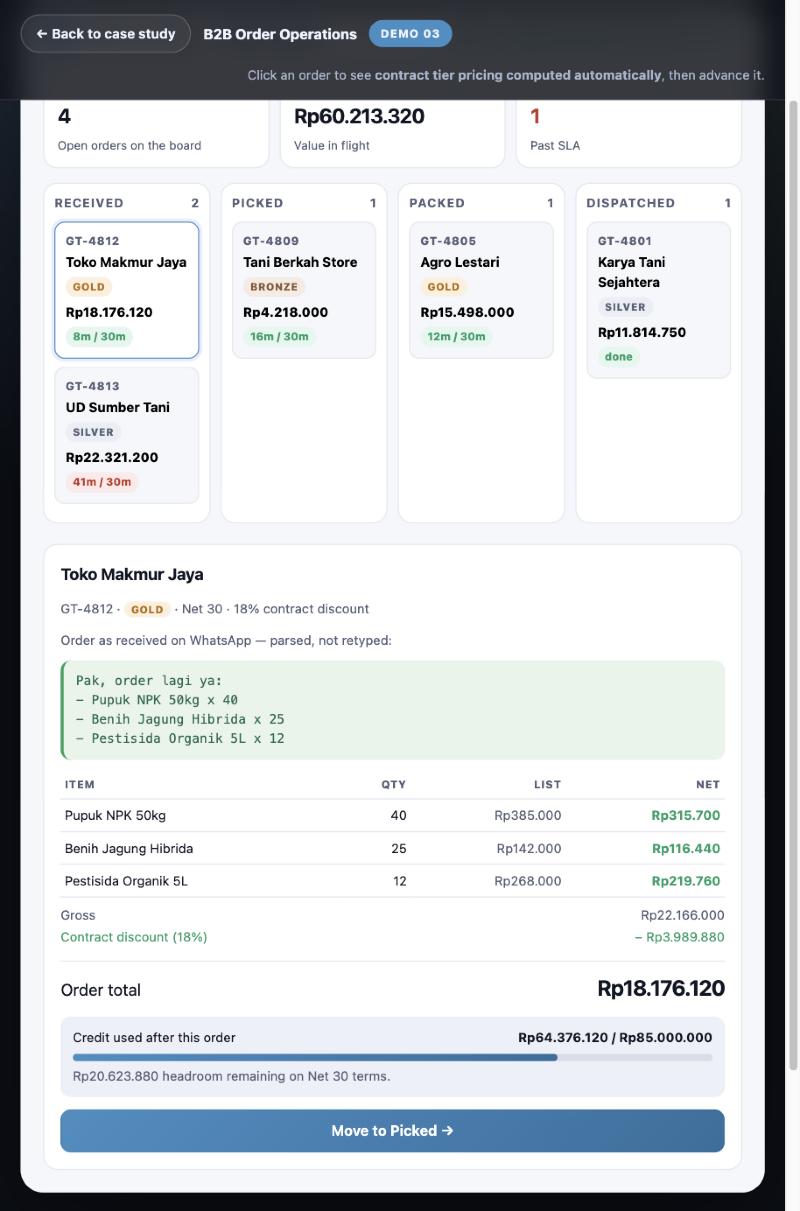
The operations board with orders moving across four stages, beside an order detail panel where contract tier pricing and credit headroom are computed automatically. Open demo ↗ Processing time −63%Entry errors −78%
03 B2B Wholesale Product Design & Ops 12 weeks

Order operations for a B2B agriculture wholesaler

Four hundred orders a day arriving as chat messages, retyped by hand into a single spreadsheet.

Problem

Retailer orders arrived as chat messages. Staff retyped them into a sheet, priced them from memory against tiered contracts, and lost roughly 9% of line items to transcription errors.

Approach

Rather than force buyers onto a new app, the messaging entry point stayed and everything after it was rebuilt: a repeat-order catalog with contract pricing applied automatically, credit terms visible at order time, and one operations board replacing the spreadsheet.

Outcome

Order-to-dispatch fell from 38 minutes to 14, and pricing disputes largely disappeared because the tier was computed rather than remembered.

−63%order processing time
−78%order entry errors
+41%reorder frequency
Open live demo ↗

Open an order to see contract tier pricing computed, then move it across the board.

Next case

Have an ecommerce problem worth taking apart?

Send the numbers you are unhappy with. I will tell you where I would look first, before any design work starts.

Start a conversation →